
Eye Protection Isn’t Optional in Commercial Cleaning
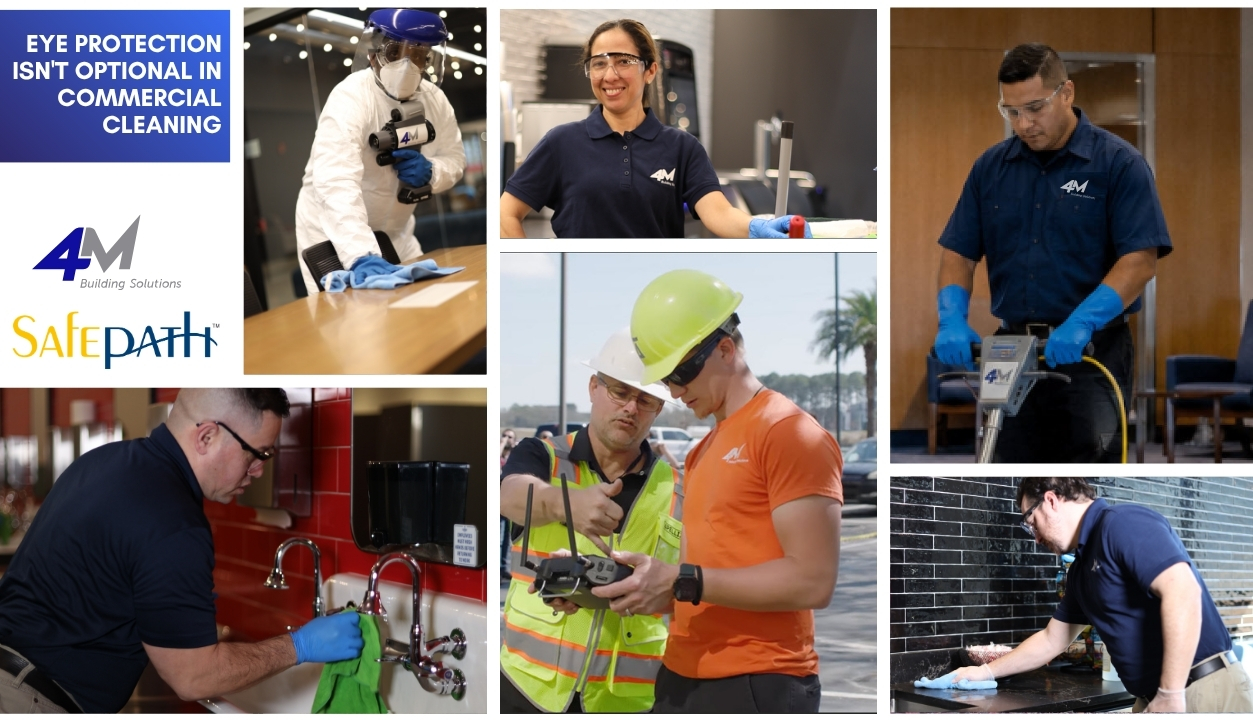
Your eyes are one of the most vulnerable parts of your body. A serious injury can happen in seconds, and the damage isn’t always reversible. For janitorial teams, that risk is a daily reality built into the job itself: chemical splashes, dust, flying debris, and pressure spray are all part of a normal shift.
Injury data shows just how frequently those risks become real injuries.
The Most Common Janitorial Injury? It’s the Eyes.
According to OSHA data cited in a 2013 industry analysis–still the most frequently referenced breakdown of janitorial injury types–40% of all janitorial injuries involve eye irritation or burns, accounting for more than any other category, ahead of skin irritation and burns (36%) and fume inhalation (12%). The same research found that cleaning workers file injury claims at roughly double the rate of the broader service industry.
These risks aren’t unique to janitorial work; they extend across virtually every type of workplace. Across all U.S. workplaces, an estimated 2,000 workers suffer an eye injury on the job every single day, costing more than $924 million a year in workers’ compensation and nearly $4 billion in lost wages and productivity, according to the Bureau of Labor Statistics (BLS). Occupational eye injuries remain a significant public health concern today, with the BLS recording more than 38,000 cases in a single recent year alone.
The encouraging part is that many of these injuries can be avoided with proper eye protection and basic safety practices. Roughly 90% of workplace eye injuries are preventable through proper eyewear and basic safety measures. And a Bureau of Labor Statistics survey found that nearly three out of five workers who suffered an eye injury weren’t wearing eye protection at the time of the accident.
Everyday Eye Hazards in Janitorial Work
Janitorial teams face eye hazards that don’t always look dangerous in the moment, making them easy to underestimate:
- Chemical splashes from cleaners and disinfectants
- Dust generated during sweeping, vacuuming, or floor work
- Flying debris during maintenance activities
- Pressure spray from bottles and equipment
None of these require a dramatic accident to cause real harm. A bottle that sprays back slightly harder than expected. A floor buffer kicks up debris. A dusting task in a room that hasn’t been cleaned in a while. Any single incident can be enough.
The simplest rule to apply before starting a task: if it could create a splash, spray, dust cloud, or flying particle, eye protection needs to be part of the plan before the task starts.
What OSHA Requires for Eye Protection (29 CFR 1910.133)
Beyond it being a best practice, eye protection in the workplace is a federal requirement. Under OSHA 29 CFR 1910.133, employers must:
- Provide eye protection suitable for the specific hazard a worker faces
- Ensure employees wear assigned eye protection whenever it’s required
- Keep damaged or defective eye protection out of use entirely
The standard exists because the risk is well documented across industries, not just cleaning. But for janitorial teams specifically, where chemical exposure and splash risk are part of nearly every shift, the requirement maps directly onto the tasks being performed that day.
If a Chemical Gets in Your Eyes, Every Second Counts
Chemical exposure to the eyes is a medical emergency, not something to wait out or monitor. If it happens:
- Stop work immediately.
- Go directly to the nearest eyewash station.
- Flush the eyes continuously for at least 15 minutes.
- Remove contact lenses if possible while flushing.
- Notify a supervisor immediately.
The 15-minute flush time comes from ANSI/ISEA Z358.1, the industry standard for emergency eyewash equipment, and should be followed whenever a chemical exposure occurs.
Not every site has a dedicated eyewash station. If one isn’t available, don’t wait. Begin flushing immediately with the nearest clean water source, such as a sink or hose, and get to a proper eyewash facility as soon as possible. Starting the flush right away matters more than finding the ideal setup.
How 4M Builds Eye Safety Into Every Month, Not Just Once a Year
Eye Protection Awareness is one part of 4M’s ongoing SafePath safety program, which covers a specific, relevant hazard Team Members will encounter on the job. SafePath is designed to keep safety discussions active throughout the year, not only after incidents occur.
The company’s safety record reflects that approach. 4M has received the BSCAI Safety Award for 29 of the last 30 years, recognizing the best safety record in the building services industry. Maintaining a best-in-class safety record requires consistent attention to training, hazard awareness, and accountability across every location.
Eye Safety Starts Before the Work Begins
Eye injuries remain the most common injury category in janitorial work, but many happen during routine tasks where proper eye protection could have reduced or eliminated the risk.
At 4M, eye protection is part of the job, supported by training, supervision, and ongoing safety education throughout the year.