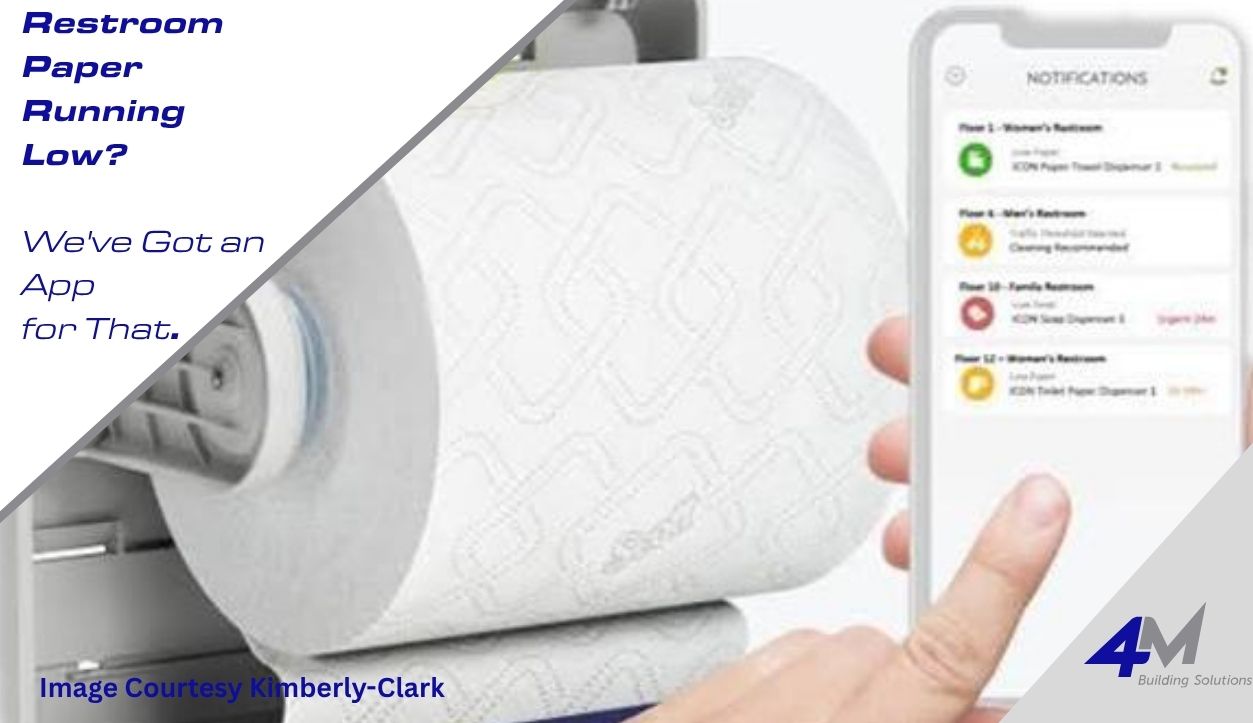
Restroom Paper Running Low? We’ve Got an App for That.
For decades, restroom inspections have followed a familiar pattern.
A member of the cleaning team walks a route, opens every restroom, checks every dispenser, and determines whether anything needs attention. Then they move on to the next restroom and repeat the process.
The challenge is that most of those inspections don’t uncover an issue.
The soap dispenser is full. The paper towels are stocked. The toilet tissue hasn’t run low. Everything is functioning exactly as expected.
Meanwhile, valuable labor hours are being spent searching for problems rather than solving them.
Today, facility technology is changing that equation.
At 4M, we’re continuously evaluating new innovations that help us deliver a more consistent facility experience, improve operational efficiency, and provide greater visibility into service delivery. One technology we’re currently introducing in select facilities is app-based restroom monitoring, which uses connected dispensers and smart sensors to notify service teams when attention is needed.
In simple terms, if restroom paper is running low, we’ve got the data to address it in real time.
While that may sound like a minor convenience, the impact can be significant for facility managers, property managers, and building occupants alike.
From Scheduled Checks to Proactive Service
Traditional restroom service is largely inspection-driven.
A facility may require dozens of restroom visits each day simply to verify that supplies remain available. Even in well-managed buildings, there is often a gap between when a condition develops and when it is discovered.
Smart restroom technology changes that model.
Connected dispensers can monitor consumable levels such as toilet tissue, paper towels, soap, and sanitizer, while mobile applications provide real-time notifications when inventory reaches predefined thresholds. Instead of checking every restroom on a fixed schedule, team members can be directed specifically to the locations that require attention.
The result is a more proactive service approach that helps prevent issues before building occupants experience them.
After all, the best restroom problem is the one nobody ever notices.
Why Restroom Experience Matters More Than Many Realize
Restrooms are often one of the most frequently visited spaces within any facility.
Whether someone is visiting a healthcare campus, office building, educational institution, manufacturing facility, or corporate headquarters, restroom conditions influence their perception of the entire environment.
When dispensers are empty, paper products are unavailable, or maintenance needs go unaddressed, occupants rarely distinguish between the restroom and the facility itself. Their perception becomes, “This building isn’t being managed well.”
Conversely, a consistently clean, stocked, and functional restroom creates confidence. It communicates attention to detail, operational discipline, and respect for occupants.
That’s why technology that helps improve restroom reliability isn’t simply about consumables. It’s about supporting the overall facility experience.
Four Reasons Smart Restroom Monitoring Benefits Facility Leaders
1. Better Occupant Experience Through Fewer Service Failures
No facility manager wants to learn about an empty paper towel dispenser from a tenant complaint.
Smart monitoring helps reduce those situations by providing alerts before supplies are completely depleted. Rather than waiting for someone to report a problem, service teams receive visibility into restroom conditions in real time.
The benefit is straightforward:
- Fewer empty dispensers
- Faster response times
- Improved occupant satisfaction
- More consistent restroom experiences
For facility leaders, that translates into fewer complaints and greater confidence that critical spaces are being maintained properly.
2. Technology for More Productive Use of Labor
Labor remains one of the largest costs within any cleaning and janitorial program.
One of the most compelling advantages of smart restroom technology is that it allows teams to spend less time searching for work and more time performing meaningful work.
Instead of inspecting every dispenser in every restroom, cleaning professionals can focus their attention on locations that the system identifies as requiring service. Real-time alerts help prioritize activity and reduce unnecessary inspections.
This creates opportunities to:
- Improve route efficiency
- Reduce redundant checks
- Focus on higher-value cleaning activities
- Improve responsiveness during peak usage periods
In other words, technology helps our teams work smarter, not harder.
3. Data-Driven Decision Making
Historically, many facility decisions have relied on assumptions.
- How frequently should a restroom be serviced?
- Which areas experience the highest traffic?
- Are supplies being replenished too often or not often enough?
Smart restroom systems provide data that helps answer those questions with greater accuracy. Usage patterns, dispenser activity, response times, and service frequencies can all be measured and analyzed.
For facility leaders, that visibility provides a stronger foundation for operational decision-making. Instead of relying on assumptions or fixed schedules, they can use real-time data to make more informed decisions about staffing deployment, cleaning schedules, resource allocation, operational planning, and service quality monitoring. The result is a facility operation that is more responsive, more efficient, and better aligned with actual building usage patterns.
At 4M, we believe data should complement experience, enabling facility strategies that are both efficient and responsive.
4. Reduced Waste and Improved Sustainability
Many facilities unintentionally replace restroom consumables before they’re actually needed.
It feels like a safe approach, but it can also result in unnecessary waste.
By providing visibility into actual usage levels, smart monitoring helps ensure products are refilled at the appropriate time rather than based solely on assumptions or schedules. This can reduce premature refills, limit product waste, and support broader sustainability initiatives.
For organizations with environmental goals, small efficiencies multiplied across dozens or hundreds of restrooms can create meaningful results over time.
Technology Is Only Valuable When It Improves Outcomes
It’s important to note that technology alone doesn’t create a great facility experience. An app doesn’t clean a restroom. A sensor doesn’t engage with tenants. A dashboard doesn’t replace a well-trained service team. Technology is most effective when it empowers people to make better decisions and deliver better service.
That’s why our approach at 4M is not to adopt technology simply because it’s new. We evaluate innovations based on their ability to improve consistency, accountability, efficiency, and outcomes for our clients.
Smart restroom monitoring is just one example of that philosophy in action.
By combining trained professionals, proven processes, and intelligent technology, we can help create environments that are cleaner, more responsive, and better aligned with the needs of today’s facilities.
The Future of Facility Services Is Connected
As facilities become more sophisticated, expectations continue to rise.
Clients are looking for greater transparency. Occupants expect consistent experiences. Facility leaders need stronger data to support operational decisions. At the same time, labor resources must be utilized as effectively as possible.
These pressures are driving the adoption of connected technologies throughout the built environment, and restroom monitoring is one example of how those innovations are delivering measurable value.
At 4M, we’re excited about the potential of technologies like app-based restroom monitoring because they support a simple goal: creating better facility experiences through smarter service delivery.
So, the next time you find your restroom paper running low, remember, we’ve got an app for that.
More importantly, we’ve got a team committed to finding innovative ways to make facilities cleaner, more efficient, and easier to manage every day.
Interested in learning how technology-driven facility services can improve reliability, visibility, and operational efficiency in your building? Contact 4M to learn how innovative solutions and Precision-Grade Clean™ processes are helping organizations create better facility experiences.