
The Hidden Risks of Floor Stripping & Waxing: What Facility Managers Need to Know
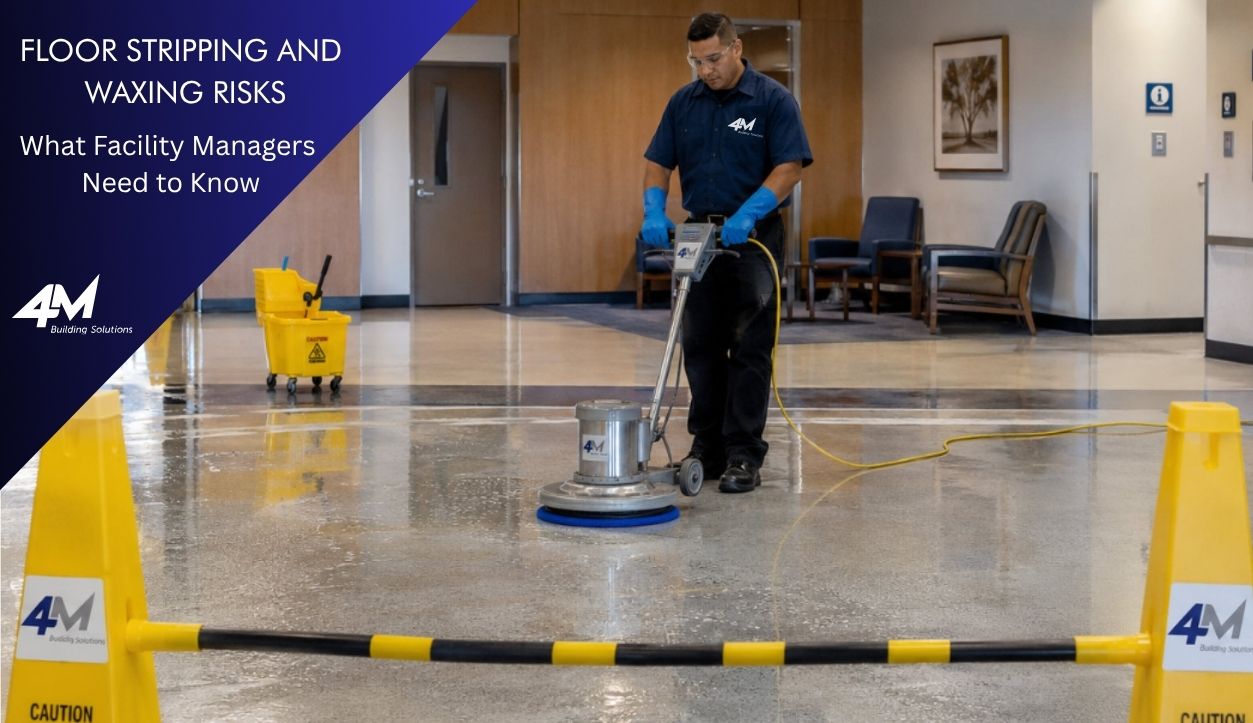
Floor stripping and waxing is often seen as just another routine maintenance activity in a facility. Just another line item in a facility maintenance plan, typically performed after hours and out of sight. But for facility managers focused on safety, operations, and risk mitigation, this work deserves much closer attention.
Behind what appears to be a standard cleaning service lies a complex, high-risk process that, if not properly managed, can create significant exposure for both the facility owner and their staff.
The data reinforces just how significant that risk can be. Each year, U.S. employers report approximately 2.5 million workplace injuries and illnesses, with falls, slips, and trips representing one of the most persistent causes of injury. [bls.gov]
In 2024 alone, these incidents were responsible for hundreds of thousands of injuries requiring time away from work and more than 800 fatalities. In environments where floor care is actively being performed, those risks increase substantially, and often in ways that are easy to underestimate. [bls.gov]
At the most obvious level, floor stripping and waxing introduces immediate slip-and-fall hazards. Wet surfaces, residue, and unfinished drying cycles create conditions where a single misstep can result in injury. The CDC notes that falls are one of the most common workplace injuries, and many of these incidents occur on the same level due to contaminants such as water or cleaning solutions on walking surfaces. [cdc.gov]
Within the cleaning industry itself, nearly half of all workplace accidents are tied to slips, trips, and falls, underscoring how central this risk is to the work being performed. For facility managers, the implication is straightforward. When cleaning is happening, the environment itself becomes temporarily hazardous and must be actively managed as such. [worldmetrics.org]
Yet the risk extends well beyond what can be seen. Floor stripping products are highly effective because they are chemically aggressive, designed to break down layers of finish quickly and efficiently. That effectiveness, however, comes with exposure risks that must be carefully controlled. Cleaning professionals can encounter skin irritation, chemical burns, or respiratory issues if products are mishandled, improperly diluted, or used in poorly ventilated environments. Industry data shows that cleaning workers experience disproportionately high rates of chemical exposure-related illness compared to the broader workforce. Without strict adherence to Safety Data Sheets (SDS), proper labeling, and handling protocols, even routine tasks can escalate into preventable safety incidents.
The tools and equipment used in floor restoration add another layer of complexity. Floor machines operate in wet environments while relying on electrical components, creating inherent risk if equipment is not properly maintained or inspected.
Additionally, damaged cords, exposed wiring, or improper use can introduce hazards not only to the cleaning crew but to anyone in the surrounding area. These risks are compounded when work is performed under time pressure or without consistent oversight, conditions that are more common than many facility managers realize.
Given all of this, the real question for facility managers isn’t just when floor stripping and waxing will be performed, but how it will be executed. Safe execution requires more than general awareness. It demands a consistent, disciplined approach that integrates safety into every step of the process.
Proper personal protective equipment must be worn at all times, including chemical-resistant gloves, eye protection, and slip-resistant footwear. Products must be handled in accordance with manufacturer instructions, with no deviation in dilution or mixing protocols. Work areas must be clearly marked and actively controlled, with restricted access and clear communication until floors are fully dry.
Ventilation must also be considered a critical control, not an afterthought. Many stripping products release vapors that can irritate the eyes and respiratory system, particularly in enclosed environments such as healthcare facilities, schools, and office buildings. Ensuring adequate airflow, whether through mechanical systems or natural ventilation, is essential to protecting both the service workers and the occupants.
Perhaps most importantly, safety in these situations must be consistent, not dependent on the crew assigned that night, and never subject to shortcuts.
One of the most common sources of risk in facility services is variability. Different teams often apply different standards, get inconsistent training, or lack real accountability in the field.
OSHA’s broader safety guidance consistently emphasizes that workplace injuries are often preventable when hazards are identified and controlled in advance. The challenge is not a lack of knowledge; it is a lack of disciplined, repeatable execution. [osha.gov]
For facility managers, this is where the role of a professional cleaning partner becomes critical. It is no longer sufficient to evaluate providers based solely on cost or surface-level outcomes. The real measure of a partner is their ability to operate with defined processes, enforce safety standards consistently, and take ownership of risk within their environment.
When process, standards, and ownership are missing, the burden shifts back to the facility, and with it, the exposure.
Floor stripping and waxing may be temporary in nature, but the consequences of poor execution are not. Injuries, liability, and operational disruption can all stem from something as simple as a wet floor or improperly handled chemical.
Conversely, when the work is done correctly, with discipline and structure, it reflects a broader commitment to safety and operational excellence that extends across the entire facility.
At 4M, we believe that safety is not a step in the process; it is the foundation. From training and preparation to execution and accountability, our approach is designed to reduce risk at every stage of service. Because protecting your floors should never come at the expense of protecting your people.
If you are evaluating your current provider or looking to strengthen safety standards in your facility, now is the time to take a closer look at how this work is being performed. Contact 4M to learn how a process-driven, safety-first approach to cleaning can help reduce risk, protect occupants, and deliver a higher standard of performance.