
What Happens During a Building Walk and How It Shapes Your Cleaning Investment
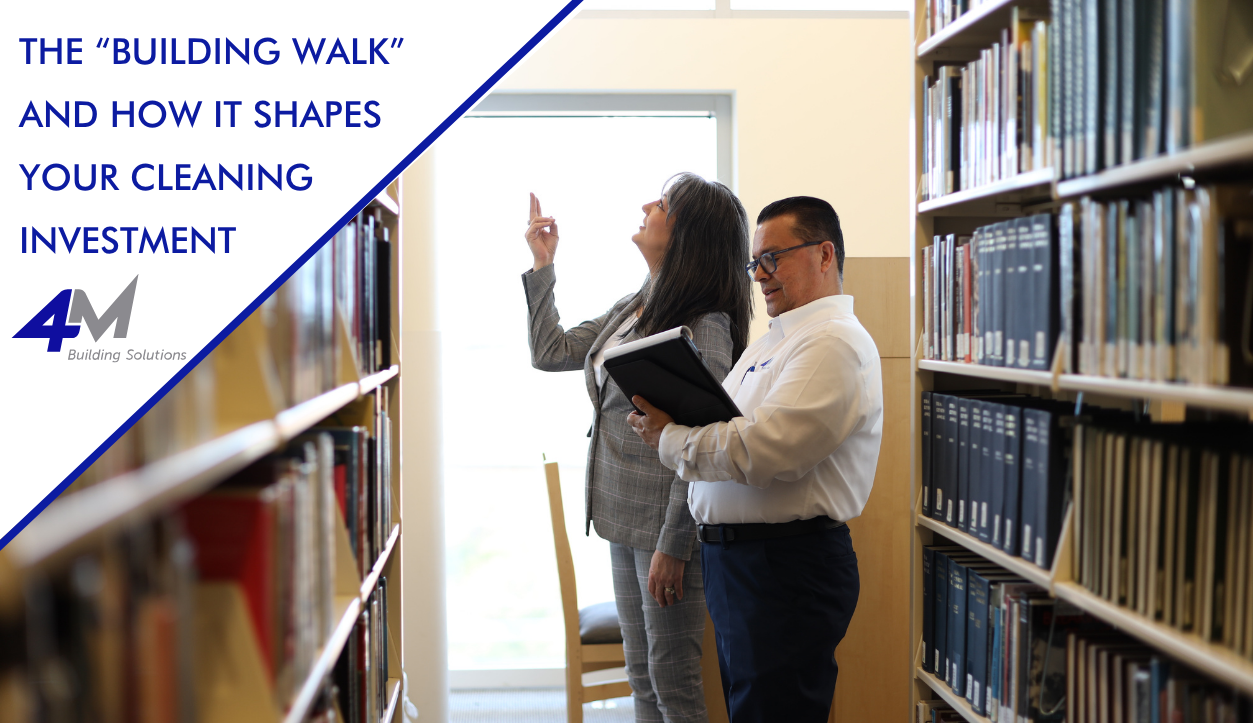
If you’re evaluating a new cleaning and janitorial partner, you’ve likely heard the term “building walk.” For many prospective clients, it can feel like a routine step, something between an initial tour and a pricing exercise. The truth is that this step is far more significant than that, and not something to be overlooked.
At 4M Building Solutions, the building walk is where everything begins. It is a structured, operational assessment designed to answer a fundamental question: What will it take to clean this facility the right way – consistently, efficiently, and at scale? The accuracy of that answer directly influences not only the proposed investment, but the long-term success of the program itself.
Put simply, the building walk is where we build the foundation for a Precision-Grade Clean™.
Understanding the Facility Beyond Square Footage
Every building has a different story, and that story cannot be captured by square footage and diagrams alone. During the walk, our priority is to understand how your space is structured and how it truly functions day to day.
We look closely at what portion of the building is actively used and what parts are vacant, how the layout is configured across floors or multiple structures, and how easily different areas can be accessed and serviced. Two facilities of similar size can operate very differently depending on layout complexity, connectivity between buildings, and how people move throughout the space. These details directly impact productivity, staffing, and ultimately the consistency of our service delivery.
Whenever possible, access to floor plans or architectural drawings allows us to take this understanding to a deeper level, but can never replace walking through the spaces with you. These walks give us the ability to map cleaning zones with precision and align labor to real conditions, rather than generalized assumptions.
Evaluating Surfaces and Service Requirements
As we move through the building, our attention naturally shifts to the environments we’ll be maintaining. Flooring types, for example, play a critical role in shaping the service model. A facility with extensive hard surfaces may require routine machine scrubbing to maintain appearance and safety, while a carpet-heavy environment calls for a different mix of maintenance and periodic care.
Restrooms receive particular focus because they are among the most labor-intensive and highly visible areas in any facility. The number of fixtures, the level of usage, and the expected standard of cleanliness all factor into how service is structured. Similarly, shared spaces like breakrooms, cafeterias, and meeting areas tend to concentrate traffic and require a higher level of ongoing attention.
Again, the goal during our walk of your building isn’t just to identify what needs to be cleaned, but to clearly understand the level of care required to maintain each space to your expectations.
How People Use the Space Matters
One of the most important insights we gather during a building walk has nothing to do with the building itself. Rather, it has everything to do with the people inside it.
Occupancy patterns often tell a very different story than square footage alone. An office with a hybrid workforce may have fluctuating demand throughout the week, while a medical office space may operate at near full capacity every day. Some buildings experience predictable peaks tied to meetings, events, or shift changes, while others have more stable, consistent usage.
Understanding how many people use the space, when they use it, and where they tend to congregate allows us to align cleaning frequency and staffing accordingly. This ensures that high-traffic areas receive the attention they need without overserving underutilized spaces. It’s a more efficient approach, and it leads to a better experience for everyone in the building.
The Operational Reality of Delivering Service
A cleaning program doesn’t operate in a vacuum (pardon the pun). It must fit seamlessly within the existing flow of your building, and this is where operational details become critical.
During our building walk, we take time to understand how our work will actually get done in your environment. That includes how waste is collected and removed, where dumpsters or compactors are located, and how service teams will navigate the building. Elevator access, for example, can significantly affect productivity depending on whether teams can use freight systems, or when they must rely on passenger elevators.
We also evaluate practical considerations like storage space for our equipment and supplies, access to water sources, and whether there are designated areas to support the cleaning operations of the bulding. In addition, we review any security requirements, including badging, escort-only areas, or restricted-access zones, along with any training or compliance expectations for our personnel working onsite.
These details may seem small in isolation, but collectively they have a meaningful impact on how efficiently and consistently your custom cleaning program can be executed.
Aligning on Expectations and Experience
Equally important to what we observe is what we learn through conversation with you. Every building walk includes time spent understanding your expectations and your current experience.
We discuss how you want the service to operate, including preferred schedules, shift timing, and whether cleaning is performed during the day, at night, or a combination of both. We also review coverage expectations for weekends and holidays, and the need for on-site management or supervisory support.
Most importantly, we ask about your current challenges. Whether it’s inconsistency in service, communication gaps, missed areas, or difficulty maintaining staffing levels, these insights help shape the program we design. Our goal is not just to meet a defined scope, but to solve the problems that led you to explore a new partner in the first place.
Information Strengthens Accuracy
While the building walk provides a comprehensive view of your facility, the most accurate service plans are built when that perspective is combined with detailed information from you and your team.
Access to floor plans allows us to validate measurements and refine our models. Clear insight into restroom fixture counts enables precise labor calculations for one of the most demanding areas of service. Understanding occupancy levels and work schedules ensures that cleaning efforts are aligned with actual usage, rather than “best practices” or assumptions.
Clarifying scope expectations (like who provides consumables, whether event support is required, or if there are specialized cleaning needs) helps eliminate ambiguity and ensures that the final proposal reflects the full picture of services required from our teams. Similarly, awareness of operational constraints, including security protocols or space limitations, allows us to design a program that is not only effective, but realistic and consistently executable within your environment.
Turning Insight Into a Cleaning Program
Once the building walk is complete, the information we gather is translated into our structured service model, and then tailored to your facility.
This includes developing a staffing plan based on our proven production rates, selecting the right equipment to match your surfaces, and defining service frequencies that reflect how your building is actually used. Quality standards and accountability measures are built into the program from the beginning, ensuring that expectations are clear, and our performance can be consistently measured and maintained over time.
The result is not just a proposal and a price, but a fully engineered approach to delivering the outcome you expect. The investment associated with the program we develop together with you is grounded in operational reality, providing clarity and confidence from the outset.
Why the Building Walk Matters
In closing, we know from our experience that many of the challenges organizations face with janitorial services can be traced back to the earliest stages of the partnership. When building walks are rushed, incomplete, or maybe never even happened in the first place, important service details are missed. When pricing is based on assumptions rather than your data, programs fall short in execution. And when expectations are not fully aligned, disappointment is inevitable.
A thorough building walk helps prevent these issues before they begin. Walking your spaces with you creates alignment, establishes clarity, and ensures that the service plan being proposed can be delivered as intended.
Building a Better Experience from Day One
At 4M Building Solutions, the building walk is more than just a step in the sales process. It’s the starting point of a true partnership and a mutual investment of time to understand your building, your operations, and your expectations at a deeper level.
That investment upfront leads to better outcomes over time. Staffing is right-sized, service is consistent, and adjustments are minimized. Most importantly, you gain confidence in us as a partner. You gain a partner who builds a bespoke cleaning program and is willing to take the time to explain not just the dollars, but the thinking and discipline behind it.
Because in the end, a better cleaning program doesn’t start with a quote, it starts with understanding. And that is exactly what a building walk with your local 4M Team Member is designed to deliver.
Let’s start the conversation. Contact us today for a no-obligation facility assessment.